Stephen Williams
B.A. M.A. LMT GCFP
Honolulu, HI USA
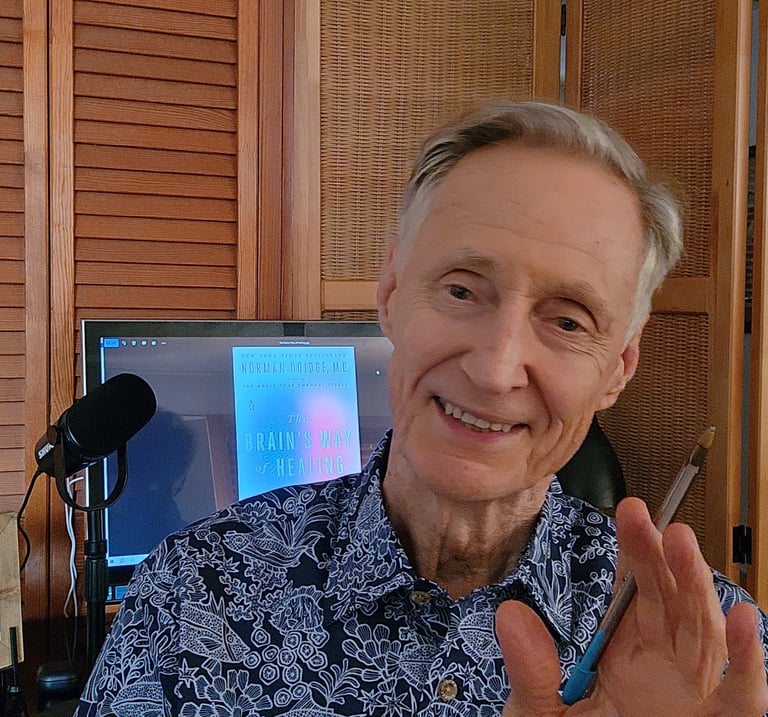
and thanks Dad, for everything !
I use the term 'Somaticist' (not to be confused with 'Somatist') to best describe those who work in the field of Somatic Awareness. With the amount of attention given to emotional, behavioral, and cognitive aspects, 'NeuroSomaticist' often seems the more appropriate label.
My work with NeuroSomatics began obscurely when I chose to integrate some elements of post-graduate Neuro-Psychology study into my practice as a Shiatsu Therapist. Truthfully, most clients had no interest in the somatic content. They just wanted their sore back or stiff neck fixed while they chatted or dozed off. But the few who came aboard helped grow my interest and understanding of what was possible.
In 2007, a bike accident left me with a painful limp that ended my physical activities for 18 months. Desperate to regain myself, I took a somatic approach to walking. Not only did I discover jogging was actually less painful than walking, but it also improved it. Thus, in August of 2008, I returned to running (sorry..." jogging") after a 40-year absence. When I spoke of "running Boston someday" to some runners one afternoon, they laughed! With strict qualifying times, the Boston Marathon often remains on one's "bucket list" for a lifetime. Having once been a runner, their response burned in me all the way home, so that very night I registered for a December marathon that could qualify me for Boston. I achieved that goal and returned to Boston 5 more times, finishing 2nd in 2012. Each effort was intended to validate the effectiveness of the NeuroSomatic work I was doing. Sadly, I never again saw the runners who had laughed at me, but the real upside to those events lies in an account seen on the Stedawi story site (links).
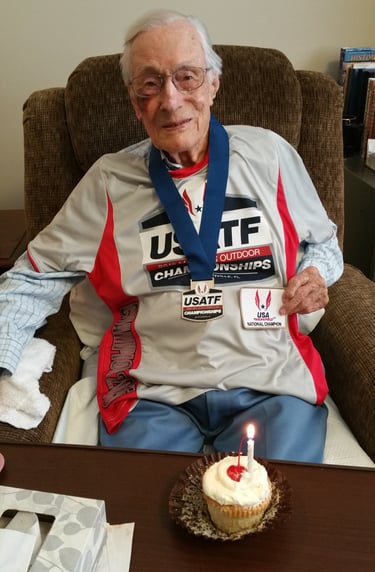
As work demands grew, I moved to the track and shorter road events, and in 2015, I presented my father with a second U.S. national title. Fifty years earlier, a newspaper had published a homecoming photo of him embracing his son, Quarterback for the 1960 Pop Warner World Champions in football. I had chatted with Walt Disney in his office as he lunched, and been kissed by film star and teen heartthrob, Annette Funicello. Does it get any better for a 12-year-old? Now it had all come full circle by gifting him with a USA gold medal on his 100th birthday. Soon after, I happened upon a woman in Berlin who analyzed runners in major events. Her comments were eerily similar to my own, so I connected with her and found that I had seen her methodology profiled in an article years earlier but had brushed it off. Had I read further, I would have seen how closely it resembled what I was doing at the time, and how genius the creator was. He had literally been a pioneer in Neuro-Plasticity, as much so as Paul Bach-y-Rita had been, just differing in approach. So a shout-out to Jae Gruenke for having given me a reason to take another look at Moshe Feldenkrais's work in somatics
sdw
Thanks for visiting,
About Me A Personalized Profile
NeuroSomatic Educator / Practitioner
In 2017, I returned to the master's U.S. Outdoor Track & Field Championships in Baton Rouge, with the dream of winning two national titles. That dream was realized, plus more. The occasion had been the perfect "Field Test" for the work I was doing. In those few years, starting with 'unable to walk' and ending with a #3 World Ranking, I discovered what was possible simply by practicing what I was teaching, but the benefits went far beyond just physical. I overhauled my entire practice, fully embracing NeuroSomatic learning and breath. It was clear what it had done for me, and I saw what it was doing for my clients. There were holdouts, and I respected that. Still, I'm sad to this day, seeing the condition they are presently in and knowing what could have been ... 'if only.' The sports accolades had felt great, but no greater than the gratitude expressed by clients who had been helped. In 2018, I chose to enter the Feldenkrais Professional Training program, extended to six years by the pandemic. I added an Advanced Breathing Instructor certification during that period. Many of us faced hardships during that time; I chose to embrace mine as opportunities, and do so still. As for the work itself, the physical and physiological benefits became obvious. But it's the profound links to recent neuroscience discoveries that now fascinate me the most. The path that leads to functional somatic awareness (breath included) does not end there, and has, in fact, set me upon my most challenging journey to date.
© 2025 [Stedawi, LLC]. All rights reserved.
You can support the site at Buy Me a Coffee (also in Links)